Balm for a saccharine day:
...the mnemonic easily tips into the memorializing, that is to say, into a demand that the historical be monumentalized, and often today what is monumentalized is the traumatic....we seem to live in a culture fixed on horrific pasts, not in a culture desirous of transfigured futures. From my perspective its political effects are disastrous: we live under the repressive dread of antidemocratic blackmails ("9/11," "the war on terrorism," etc). - Hal Foster
Tuesday, September 12, 2006

Monday, August 28, 2006
From an SF Bay Guardian article on the dispersed sound of the Dying Californian, whose members live in Los Angeles, Berkeley and San Francisco:
Dalton has lived in California most of his life, long enough — and far and wide enough — to know that "most people in Northern California have definite opinions about LA, and people in LA are just kind of oblivious." I tell him that a friend of mine once made this observation to me after a stereotypical Mission hipster threw attitude at him upon hearing he was moving back to LA. "That's why LA wins," Dalton agrees with a laugh. "It says, ‘What? You hate us!?’”
The DC also provide the soundtrack to many of Cathy Begien's videos.
Dalton has lived in California most of his life, long enough — and far and wide enough — to know that "most people in Northern California have definite opinions about LA, and people in LA are just kind of oblivious." I tell him that a friend of mine once made this observation to me after a stereotypical Mission hipster threw attitude at him upon hearing he was moving back to LA. "That's why LA wins," Dalton agrees with a laugh. "It says, ‘What? You hate us!?’”
The DC also provide the soundtrack to many of Cathy Begien's videos.
Friday, August 04, 2006
Thursday, August 03, 2006
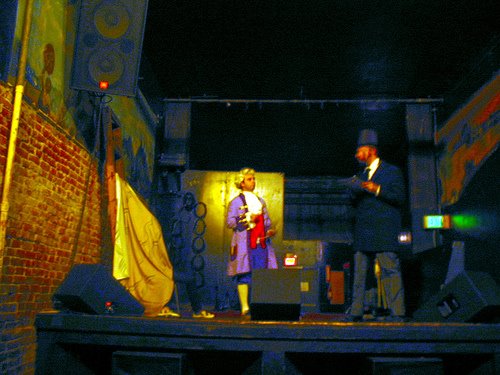
Stan Apps has a pretty decent overview of the experimental theatre event held last weekend at the Smell. And K. Lorraine Graham has some flickr pictures of her LA weekend, including the plays. The photo below is from Lorraine's series (Lorraine, I hope you don't mind I've pilfered it!). That's me in the French marquis outfit. Andrew Maxwell is Abe Lincoln. Rita Gonzalez is on the left, obscured by a sheet/curtain/sail.

Tuesday, August 01, 2006
We’re having a timely conversation over at Stan Apps’ blog about violence, aesthetics, the
Friday, July 28, 2006
Vast Arcade Los Angeles
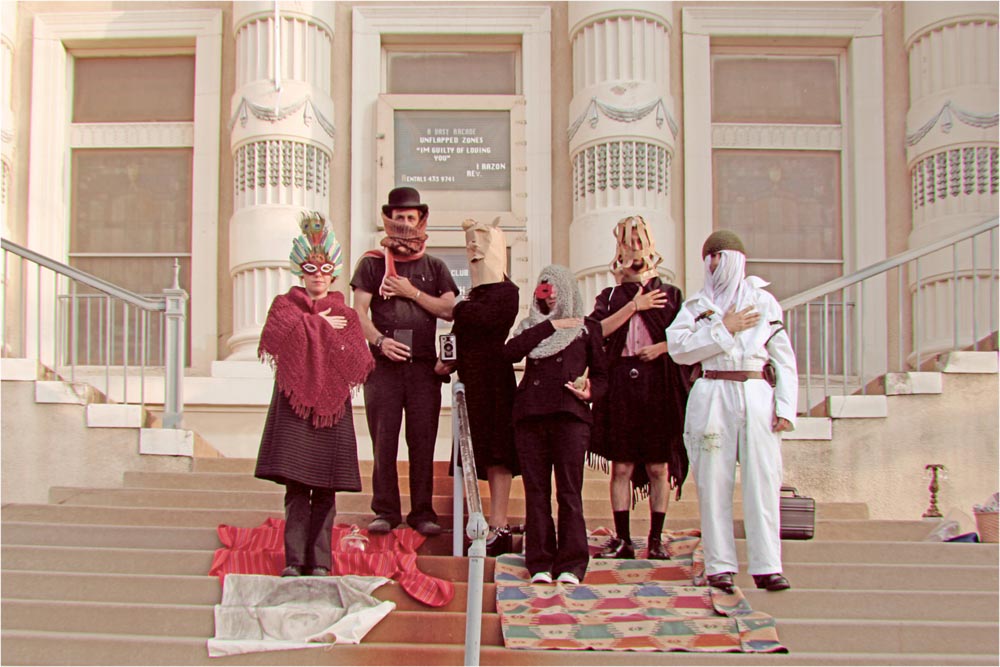
(click on photo to enlarge)
“Dr. Eufencio Rojas!”...
“Presente”
“Liki Renteria!”...
“Ehh!”
“George Lopez”...
(Silence)
“El Pendejo!!”...
“Soy Yo!”
“Antonio Villaraigosa!"...
(Sound of locked jawbone cracking)
“Dr. Renato Frias!"...
(Low frequencies)
All are gathered here to pick up the parts and play with the remnants of Sr. Romo’s backhands.
First, let’s examine this document entitled, The Crystal Brilliance Manifesto. We have all studied The Art of Noises, have we not? Do you sense a rupture in the seams of 20th century art history now that we have come to a point where we can conjure the Futurists perfectly at home on Whittier Blvd?
Your Crystal Brilliance Manifesto loops los planes (which we remember were penned with blood, cactus, and semen) with the escritos of David Alfaro Siqueiros. His seemingly hazardous development was “an antinomic double objective: on one hand, encouraging the development of "new means" for literature and the visual arts through the incorporation of avant-garde principles; on the other, the promotion of truly independent perspectives based on the recovery of indigenous traditions.” (Mari Carmen Ramirez)
Romo, you penned, “Think of a mural dedicated to double vision, to sound, to the dead twin of the puff of smoke that you released from your lungs one night, to the long faded trails of movement left behind by your hands pushing into the concrete. Sounds should pass through your mind about now, wooshes and abstract noises and fractal like guffaws, hoots and car horns."
And then a crash defines the disso-stinct…and then we see the cinematic trails of Siqueiros project which somehow landed in Sergei Eisenstein’s erotic film bins.
Sr. Romo, think back to the Futurists’ dream of a mural dedicated to sound—think of Russolo’s praise of the-- “crashing down of metal shop blinds, slamming doors, the hubbub and shuffling of crowds, the variety of din, from stations, railways, iron foundries, spinning mills, printing works, electric power stations and underground railways…” (Russolo 85 Futurist Manifestos, edited by Umbro Apollonio, Boston, Museum of Fine Arts Publications, 2001: 74-77.)-from Vast Arcade Los Angeles: An Introduction to the Project by way of an Interview Conducted by Rita Gonzalez at the Home of Arturo Romo, 8/20/05
Arturo Romo's Vast Arcade Los Angeles can currently be seen along with Kalup Linzy's All My Children at LAX Art in Los Angeles.
Thursday, July 27, 2006
This should go in the comments section of Silliman’s Blog, but he’s turned his comments off, so I’ll respond here.
In response to Sherwood Anderson’s 1918 poem “Song to New Song”, Ron writes:
Several things in this text stand out, above & beyond the obvious influence of Whitman. One is the fact that there is nothing personal here about the use of the first person singular. Is “I” here even a person? More accurately, it strikes me as a rhetorical position. Nor is there anything personal, even personified, about “you,” bird man of the furnaces. Rather, this is a kind of public, figurative language we hardly hear any more, save possibly in church. If it seems preposterous or stilted or dated, that is the index of just how far outside our expectations such language is today within the poem.
Ron is referring to Sherwood Anderson’s rhetorical, and presumably communal, use of I and you: “I greet thee, horse and terrible singer, half man, half bird, strong, winged one./I see you float in cold bleak winds,/Your wings burned by the fires of furnaces…”
My first thought was that this language is epic language, and that indeed one occasionally does find such language used in contemporary poetry, if only ironically . My second thought was of Juliana Spahr and her repeated address to “Beloveds” and her use of the rhetorical I in her book This Connection of Everyone with Lungs (Spahr was also ready-at-mind for Gabe Gudding). Finally, I recalled the very common use of infinitives that function rhetorically, figuratively, and publicly, and that are often composed as lists in much contemporary poetry. This sort of infinitival excessiveness is the syntactic soft spot into which the public I and rhetorical you have recently wiggled: “To labor night and day/To bear rain or wind/To eat badly and to sleep badly, etc., etc.” In Heretical Imperialism Pier Paolo Pasolini calls this the “inchoative infinitive”:
…. “inchoative,” that is, as description of repeated actions – always because of a normativity alluded to with the absolute certainty of being understood, of exciting sympathetic sentiments in other people who not only have had similar experiences but who don’t even have the possibility of thinking for themselves of different experiences….The infinitival category […] in any case implies a humble and, I would say, labor-union-like epic quality: and so it does not imply only a simple “reanimation” of the speech of a speaker as a statistically and above all socially individualized particular character, but of a typical speaker, a representative of a whole category of speakers, thus of a milieu, even a people….The sympathy of the author in reanimating his speech grammatically thus doesn’t go out to him, but to all those like him, to his world.
This Weekend in Los Angeles
Poet's Theatre at the Last Sunday of the Month Reading Series
@The Smell
Plays
The Mummer's Play by Vanessa Place
starring Christine Wertheim, Matias Viegener, Teresa Carmody, Vanessa Place, and Maude Place as Twing Twang
Bad Fuggums by Joseph Mosconi
starring Andrew Maxwell, Rita Gonzalez, and Joseph Mosconi
Rootbots by Matt Timmons
starring Steph Rioux, Stan Apps, and Matt Timmons
excerpts from Conduction in the Catacombs, by Will Alexander
starring Tova Cooper and Alison McDonell
Optimist Meets Pessimist by Stan Apps
starring Brook Haley and Jen Rust
What Do You Know of Ghosts? by K. Lorraine Graham
starring K. Lorraine Graham and Mark Wallace
sections from Dark Carnival by Mark Wallace
starring K. Lorraine Graham and Mark Wallace
Balm to Bilk by Rodrigo Toscano
starring K. Lorraine Graham and Mark Wallace
Monkeys in the House by Harold Abramowitz
starring Steph Rioux, Stan Apps, and Matt Timmons
------------
Doors open at 6:30. $5 at the door to support artistes.
The Smell
247 S. Main Street
Los Angeles, CA
Please don't throw rotten vegetables. I've never written a play before.
Also:
The 3rd installment of Long Beach Notebook
Saturday, July 29, 8PM
Aaron Kunin
Jen Benka
&
Ara Shirinyan
Aaron Kunin is the author of Folding Ruler Star (Fence Books, 2005), a collection of small poems about shame. The Mandarin, a novel, is forthcoming in 2007. He lives in California and teaches negative anthropology at Pomona College.
Ara Shirinyan is writer and editor of Make Now Press in Los Angeles. He curates the Last Sunday of the Month Reading Series at the Smell in Los Angeles with Stan Apps and Teresa Carmody. His chapbook Handsome Fish Offices is due out later this year on INSERT PRESS.
Jen Benka's collection, A Box of Longing With Fifty Drawers, which is comprised of one poem for each of the 52 words in the Preamble, was published by Soft Skull Press in 2005. She is also the author of the Eisner-nominated indy comic book series, Manya. She is the recipient of grants and awards from Intermedia Arts, the Poetry/Film Workshop, Wisconsin Arts Board, and the Xeric Foundation. She works as the managing director of Poets & Writers, and on the side, organizes poetry events, which have included a 24-hour marathon reading of the complete poems of Emily Dickinson, a protest reading during the 2005 Republican National Convention, and currently, a 5-night festival celebrating women poets. She lives in New York City.
LONG BEACH NOTEBOOK is held at the home & office of Palm Press:
143 Ravenna Drive
Long Beach, CA 90803
@The Smell
Plays
The Mummer's Play by Vanessa Place
starring Christine Wertheim, Matias Viegener, Teresa Carmody, Vanessa Place, and Maude Place as Twing Twang
Bad Fuggums by Joseph Mosconi
starring Andrew Maxwell, Rita Gonzalez, and Joseph Mosconi
Rootbots by Matt Timmons
starring Steph Rioux, Stan Apps, and Matt Timmons
excerpts from Conduction in the Catacombs, by Will Alexander
starring Tova Cooper and Alison McDonell
Optimist Meets Pessimist by Stan Apps
starring Brook Haley and Jen Rust
What Do You Know of Ghosts? by K. Lorraine Graham
starring K. Lorraine Graham and Mark Wallace
sections from Dark Carnival by Mark Wallace
starring K. Lorraine Graham and Mark Wallace
Balm to Bilk by Rodrigo Toscano
starring K. Lorraine Graham and Mark Wallace
Monkeys in the House by Harold Abramowitz
starring Steph Rioux, Stan Apps, and Matt Timmons
------------
Doors open at 6:30. $5 at the door to support artistes.
The Smell
247 S. Main Street
Los Angeles, CA
Please don't throw rotten vegetables. I've never written a play before.
Also:
The 3rd installment of Long Beach Notebook
Saturday, July 29, 8PM
Aaron Kunin
Jen Benka
&
Ara Shirinyan
Aaron Kunin is the author of Folding Ruler Star (Fence Books, 2005), a collection of small poems about shame. The Mandarin, a novel, is forthcoming in 2007. He lives in California and teaches negative anthropology at Pomona College.
Ara Shirinyan is writer and editor of Make Now Press in Los Angeles. He curates the Last Sunday of the Month Reading Series at the Smell in Los Angeles with Stan Apps and Teresa Carmody. His chapbook Handsome Fish Offices is due out later this year on INSERT PRESS.
Jen Benka's collection, A Box of Longing With Fifty Drawers, which is comprised of one poem for each of the 52 words in the Preamble, was published by Soft Skull Press in 2005. She is also the author of the Eisner-nominated indy comic book series, Manya. She is the recipient of grants and awards from Intermedia Arts, the Poetry/Film Workshop, Wisconsin Arts Board, and the Xeric Foundation. She works as the managing director of Poets & Writers, and on the side, organizes poetry events, which have included a 24-hour marathon reading of the complete poems of Emily Dickinson, a protest reading during the 2005 Republican National Convention, and currently, a 5-night festival celebrating women poets. She lives in New York City.
LONG BEACH NOTEBOOK is held at the home & office of Palm Press:
143 Ravenna Drive
Long Beach, CA 90803
Thursday, July 20, 2006
 E-Mail Spam as a Masterpiece in the Making
When Romanian artist Alex Dragulescu looks at junk e-mails, he sees patterns - bits and bytes that can be manipulated into colorful plantlike images or stark architectural forms.
As a graduate student at the University of California, San Diego, he and fellow student Tim Jaeger collected spam and used it to create live multimedia shows of sound, text, and animation - "like a VJ and DJ performance," Mr. Dragulescu says in a phone interview.
..............................................................................................
Monday, July 17, 2006
The Neo-Benshi craze finally found its way to Los Angeles.

Only here it's called Da Benshi in order to differentiate it from the Bay Area chapter. Like Berlin and Zurich DaDa?
Amar Ravva and Harold Abramowitz are curating the bi-monthly live film (or video) narration series at Beta-Level in Chinatown (Da Benshi Code is the official series name).
The Mask of Zardoz is its logo.
Saturday night was Episode 1: My Dog Benshi, featuring "Jury Duty" by Oliver Hall (A Few Good Men served as the source text; instead of being court-martialed, Jack Nicholson was brought to court for...); "Monster" by Jason Brown (Jason used a sampler and turntable to narrate a collage of silent monster films); and "Bubonic Phonics" by DJ Eng (found footage of a squirrel met a live human chorus shouting "Bu-bo-nic Plague!").
The highlight of the night, however, was "Goooaaalll!!!" by Stan Apps and Mathew Timmons. Stan was out of town, so his disembodied pre-recorded voice ineracted with Matt's live narration as they scoured the tubby universe of Spanish commercials and trash television.
Guess who they found there?
Jim Behrle, "the poet capitalist", "the fruit of the loom of romanticism".
Lucky for us, Stan and Matt have taken a video polaroid for posterity.
Watch Goooaaalll!!! by Stan Apps and Mathew Timmons on YouTube:
Part 1
Part 2
And check out Harold Abramowitz's chapbook Three Column Table out now on Insert Press (no website yet, but query Stan or Matt for copies).

Only here it's called Da Benshi in order to differentiate it from the Bay Area chapter. Like Berlin and Zurich DaDa?
Amar Ravva and Harold Abramowitz are curating the bi-monthly live film (or video) narration series at Beta-Level in Chinatown (Da Benshi Code is the official series name).
The Mask of Zardoz is its logo.
Saturday night was Episode 1: My Dog Benshi, featuring "Jury Duty" by Oliver Hall (A Few Good Men served as the source text; instead of being court-martialed, Jack Nicholson was brought to court for...); "Monster" by Jason Brown (Jason used a sampler and turntable to narrate a collage of silent monster films); and "Bubonic Phonics" by DJ Eng (found footage of a squirrel met a live human chorus shouting "Bu-bo-nic Plague!").
The highlight of the night, however, was "Goooaaalll!!!" by Stan Apps and Mathew Timmons. Stan was out of town, so his disembodied pre-recorded voice ineracted with Matt's live narration as they scoured the tubby universe of Spanish commercials and trash television.
Guess who they found there?
Jim Behrle, "the poet capitalist", "the fruit of the loom of romanticism".
Lucky for us, Stan and Matt have taken a video polaroid for posterity.
Watch Goooaaalll!!! by Stan Apps and Mathew Timmons on YouTube:
Part 1
Part 2
And check out Harold Abramowitz's chapbook Three Column Table out now on Insert Press (no website yet, but query Stan or Matt for copies).
Tuesday, July 11, 2006
Oh yeah? This morning I received this:
"Well, are you pleased?"
He was glowing, positively radiant, grinning as good as the best of any literature. Looked clean. The antennas screwed up the effect though--they were overgrown instructor's level.
"Well, are you pleased?"
He was glowing, positively radiant, grinning as good as the best of any literature. Looked clean. The antennas screwed up the effect though--they were overgrown instructor's level.
Friday, July 07, 2006
Went to see the Dying Californian, my old college housemates, play at Mr. T's Bowl. Saw perhaps the best men's room grafiti ever:
"Fuck this existentialist drama."
-Louis Ferdinand Celine
"Fuck this existentialist drama."
-Louis Ferdinand Celine
Japanese improvisationalist Tetuzi Akiyama brought his guitars (acoustic, electric, mystic) to the experimental music series at the Schindler House last month for his first ever performance in Los Angeles. The night was cool, the crickets were chirping, and the occasional helicopter cruised by in the distance overhead as Akiyama strummed his acoustic, and then, after a short Campari break, boogied with his electric. I don’t own the vocabulary of a music critic, but I would guess that Akiyama’s acoustic noisy twangs & plucks are greatly influenced by Derek Bailey. The electric half of the show was conceptual: Akiyama essentially played a single classic rock riff for, oh, five to ten minutes, and then switched to another classic rock riff, which was also repeated for several minutes. It was very “dorm room”, but as my friend Jon said, the entire “rock” portion of the performance was put into relief by the more experimental acoustic half; many Derek Bailey style experimentalists can easily play “rock” but it’s not often that the rockers can play Derek Bailey.
Friday, June 30, 2006
I know, I know. I complained about crass promotion and that's all I'm doing lately. Reading reports to come. But tonight there are two to choose from.
Beyond Baroque, 681 Venice Blvd. Venice, CA, 7:30pm
TOM ORANGE, K. LORRAINE GRAHAM, MARK WALLACE, and CATHERINE DALY
Come celebrate the spirit of post moot, including but not limited to all forms of experimental poetic work that are both live and exist as objects. TOM ORANGE has co-curated the in your ear reading series at the District of Columbia Arts Center and edited the dcpoetry.com website and anthologies since Fall 2000 . CATHERINE DALY is author of DaDaDa, Locket, Secret Kitty, and To Delite and Instruct . MARK WALLACE is author of a number of books of poems, most recently Temporary Worker Rides A Subway . K. LORRAINE GRAHAM is author of two chapbooks, Dear (Blank) I Believe in Other Worlds (Phylum) and Terminal Humming (Slack Buddha
or
Incendiary Spirals, Words and Music at The Space at Fountain's End
3929 Fountain Ave., Los Angeles CA, 8pm
Will Alexander
Estrella del Valle
Jen Hofer
Anthony Seidman
Alan Semerdjian
Jane Sprague
Beyond Baroque, 681 Venice Blvd. Venice, CA, 7:30pm
TOM ORANGE, K. LORRAINE GRAHAM, MARK WALLACE, and CATHERINE DALY
Come celebrate the spirit of post moot, including but not limited to all forms of experimental poetic work that are both live and exist as objects. TOM ORANGE has co-curated the in your ear reading series at the District of Columbia Arts Center and edited the dcpoetry.com website and anthologies since Fall 2000 . CATHERINE DALY is author of DaDaDa, Locket, Secret Kitty, and To Delite and Instruct . MARK WALLACE is author of a number of books of poems, most recently Temporary Worker Rides A Subway . K. LORRAINE GRAHAM is author of two chapbooks, Dear (Blank) I Believe in Other Worlds (Phylum) and Terminal Humming (Slack Buddha
or
Incendiary Spirals, Words and Music at The Space at Fountain's End
3929 Fountain Ave., Los Angeles CA, 8pm
Will Alexander
Estrella del Valle
Jen Hofer
Anthony Seidman
Alan Semerdjian
Jane Sprague
Sunday, June 25, 2006
The Smell Last Sunday of the Month Reading Series
Featuring Aaron Kunin, Stacey
Levine, Matthew Stadler, and Stephen Ratcliffe.
The Smell, 247 S. Main Street, Los Angeles,
Sun, June 25, 6:30 pm, $5, (323) 304-2277.
Aaron Kunin writes poetry, criticism, and novels. Recent work has appeared in Boog City, No: A Journal of the Arts, The Poetry Project Newsletter, The Poker, and elsewhere. His book, Folding Ruler Star, has been published by Fence Books, and his e-chapbook The Mauberly Series can be downloaded from ubu editions. His work is in a minimalist tradition of strictly limited vocabularies and word-counts, and yet simultaneously revisits the themes or structures of classic works by poets like Milton and Pound. Aaron teaches 17th century literature at Pomona College.
Stacey Levine is a Seattle-based author. Her books include My Horse and Other Stories and Dra--, a novel, both published by Sun & Moon Press; her novel Frances Johnson was recently published by Clear Cut Press. She has written for the American Book Review, Bookforum, Nest, The Seattle Times, The Stranger, and more frightening venues. Formerly a creative writing instructor, she is now working on a second collection of short fiction.
Matthew Stadler is a novelist (Allan Stein, The Sex Offender, Landscape: Memory) and a contributor to Artforum, The Organ, Dwell, The Oregonian, Frieze, Domus, and others. He was the literary editor of Nest magazine and is co-founder and editor of Clear Cut Press.
Stephen Ratcliffe's latest books of poetry are Portraits & Repetition (The Post-Apollo Press, 2002) and SOUND/(system) (Green Integer, 2002). Recent poems have appeared in 1913, Chain, Denver Quarterly, P-QUEUE, New American Writing, LIT, Bombay Gin, Common Knowledge, War & Peace, Conjunctions and NO. Listening to Reading, a book of essays on sound/shape and meaning in experimental poetry, was published by SUNY Press in 2000. He has recently completed a 1,000 page book of poems called HUMAN / NATURE (1,000 poems written in 1,000 consecutive days). He lives in Bolinas, California where he publishes Avenue B, and teaches at Mills College in Oakland.
Smell Last Sunday of the Month Reading Series is sponsored by Insert Press, Les Figues Press, Make Now Press, and supported by Poets & Writers, Inc, through a grant it has received from The James Irvine Foundation.
Levine, Matthew Stadler, and Stephen Ratcliffe.
The Smell, 247 S. Main Street, Los Angeles,
Sun, June 25, 6:30 pm, $5, (323) 304-2277.
Aaron Kunin writes poetry, criticism, and novels. Recent work has appeared in Boog City, No: A Journal of the Arts, The Poetry Project Newsletter, The Poker, and elsewhere. His book, Folding Ruler Star, has been published by Fence Books, and his e-chapbook The Mauberly Series can be downloaded from ubu editions. His work is in a minimalist tradition of strictly limited vocabularies and word-counts, and yet simultaneously revisits the themes or structures of classic works by poets like Milton and Pound. Aaron teaches 17th century literature at Pomona College.
Stacey Levine is a Seattle-based author. Her books include My Horse and Other Stories and Dra--, a novel, both published by Sun & Moon Press; her novel Frances Johnson was recently published by Clear Cut Press. She has written for the American Book Review, Bookforum, Nest, The Seattle Times, The Stranger, and more frightening venues. Formerly a creative writing instructor, she is now working on a second collection of short fiction.
Matthew Stadler is a novelist (Allan Stein, The Sex Offender, Landscape: Memory) and a contributor to Artforum, The Organ, Dwell, The Oregonian, Frieze, Domus, and others. He was the literary editor of Nest magazine and is co-founder and editor of Clear Cut Press.
Stephen Ratcliffe's latest books of poetry are Portraits & Repetition (The Post-Apollo Press, 2002) and SOUND/(system) (Green Integer, 2002). Recent poems have appeared in 1913, Chain, Denver Quarterly, P-QUEUE, New American Writing, LIT, Bombay Gin, Common Knowledge, War & Peace, Conjunctions and NO. Listening to Reading, a book of essays on sound/shape and meaning in experimental poetry, was published by SUNY Press in 2000. He has recently completed a 1,000 page book of poems called HUMAN / NATURE (1,000 poems written in 1,000 consecutive days). He lives in Bolinas, California where he publishes Avenue B, and teaches at Mills College in Oakland.
Smell Last Sunday of the Month Reading Series is sponsored by Insert Press, Les Figues Press, Make Now Press, and supported by Poets & Writers, Inc, through a grant it has received from The James Irvine Foundation.
Tuesday, June 20, 2006
This is probably old news to the tech-savvy, but my favorite Daily Show Correspondent has a hilarious conceptual song/poem in which he reads 700 hobo names. It's called Hobo Names. It lasts an hour.
Friday, June 16, 2006
May all my rejected essay proposals become blogposts....

Lisa Lapinski, a Los Angeles-based artist, exhibits a marked fascination with esoteric systems of thought and the limits of language in her installation and sculptural work. For herArt Center graduate exhibition “Armstrong Visions Solarian: Regina

Lisa Lapinski, a Los Angeles-based artist, exhibits a marked fascination with esoteric systems of thought and the limits of language in her installation and sculptural work. For her
Thursday, June 15, 2006
Tuesday, June 13, 2006
To read Bay Poetics is to once again feel that strange combination of excitement, envy, and caution that may be the condition of the Los Angeles writer. Maybe it’s called ambivalence. Stephanie Young has put together a compelling Bay Area anthology. It’s filled with favorite writers and many new-to-me poets. Youngsters alongside codgers, ellipticists alongside narratologists, dogs alongside cats, et cetera, et cetera. And yet: I already know that the Bay Area has an amazing writer’s culture; it has some of the best reading series in the country, a storied history, Small Press Distribution is based there; from my perch down in Southern California, the Bay Area looks like poet’s paradise; of course it’s going to produce excellent anthologies. It seems so unproblematic. The Southland on the other hand….
Every year, usually around the time of the Festival of Books, the Los Angeles Times publishes an article that attempts to debunk the myth of Los Angeles as an unliterary city. I love myths. They index real-world phenomena. And those perennial articles are a load of crap. Los Angeles isn’t a literary city. Never has been. The Festival of Books is an industry affair, a front for the newspaper book review. We had Zizek at a Santa Monica bookstore and less than twenty people showed up. The guy introducing him didn’t even know how to pronounce his name. I remember going to some of the readings Andrew Maxwell used to put on at Dawson’s Books a few years ago; I was embarrassed at some of the turnouts (as I’m sure Andrew was as well…most of the readings were excellent, and some of the turnouts were great; but you know, how do you apologize to a poet when she's flown in from across the country and only two people show up?)
So Southern California is not really a literary place, but it does have a literary history, and there are a ton of poets here (a few months ago Catherine Daly made a list of Southern California poets on her blog – she has since taken it down – but it numbered over 650). And it’s not as if we don’t have a plethora of reading series and salons and festivals; there’s the Last Sunday of the Month reading series at the Smell, Jen Hofer’s Moving Word film and poetry series, Jane Sprague’s Long Beach Notebook, the High Energy Constructs series, Douglas Messerli’s Green Integer Salons, the yearly experimental writing conferences at the Redcat, the new Middle Monday of the month reading series at the Coffee Fix, Beyond Baroque, the LA Lit podcast…but somehow the Southern California poetry scene does not cohere in the way the Bay Area seems to (maybe the Bay Area just seems coherent from my point-of-view, but I doubt it). (And I see that Bay Poetics was originally meant to be an issue of Jack Kimball's The East Village, following up on the LA/NY issue; of which, the LA section, compared to both the online New York section and the print Bay Area section, is not nearly as expansive and seems somewhat narrow in its selection). Los Angeles is certainly not on the top of the list for traveling readers. “What? So-and-so New York poet is reading in San Francisco? Can’t we get her to come and read in LA?” Well…
Part of the problem may be that Southern Californian poets don’t seem to like publicity, and New York and San Francisco seem to have literary genes built into their DNA; Angelenos live in the shadow of Hollywood; publicity in that context just seems crass, insincere. “After all, we have no coherent literary scene. You have to drive 45 minutes across town just to go to a reading.” There also has never been a really great anthology for the area. (Green Integer recently put out a good anthology, but it was justly criticized for having an average age of 56). And many Los Angeles writers are vehemently anti-provincial; the very mention of a Los Angeles or Southern California anthology makes some shudder. “What would we call it,” said a friend, “Freeway Poetics?” Said another: “I just don’t believe in articulating a poetics based on location, especially this location.” But precisely because a Los Angeles/Southern California poetry anthology would be so problematic may be reason enough to attempt one. I don’t know, maybe not. But I’d like to hear what others think.
Back to Bay Poetics: I love the way it begins, with Brenda Hillman’s brief poem; I love the arrangement, what Stephanie Young calls “the ecology between writers…like overlapping circles with some points and clusters around the edge,” so that Kevin Killian and Dodie Bellamy are right next to each other, and likewise A Tonalists Laura Moriarty and Brent Cunningham (a fie on alphabetization!); and I love reading work by writers like Dan Fisher, whom I’ve long known but never seen in print.
And oh yeah: the Jack Spicer excerpt on the back of the book is a nice touch; it's a relief to turn the book over and see poetry instead of blurbs.
Every year, usually around the time of the Festival of Books, the Los Angeles Times publishes an article that attempts to debunk the myth of Los Angeles as an unliterary city. I love myths. They index real-world phenomena. And those perennial articles are a load of crap. Los Angeles isn’t a literary city. Never has been. The Festival of Books is an industry affair, a front for the newspaper book review. We had Zizek at a Santa Monica bookstore and less than twenty people showed up. The guy introducing him didn’t even know how to pronounce his name. I remember going to some of the readings Andrew Maxwell used to put on at Dawson’s Books a few years ago; I was embarrassed at some of the turnouts (as I’m sure Andrew was as well…most of the readings were excellent, and some of the turnouts were great; but you know, how do you apologize to a poet when she's flown in from across the country and only two people show up?)
So Southern California is not really a literary place, but it does have a literary history, and there are a ton of poets here (a few months ago Catherine Daly made a list of Southern California poets on her blog – she has since taken it down – but it numbered over 650). And it’s not as if we don’t have a plethora of reading series and salons and festivals; there’s the Last Sunday of the Month reading series at the Smell, Jen Hofer’s Moving Word film and poetry series, Jane Sprague’s Long Beach Notebook, the High Energy Constructs series, Douglas Messerli’s Green Integer Salons, the yearly experimental writing conferences at the Redcat, the new Middle Monday of the month reading series at the Coffee Fix, Beyond Baroque, the LA Lit podcast…but somehow the Southern California poetry scene does not cohere in the way the Bay Area seems to (maybe the Bay Area just seems coherent from my point-of-view, but I doubt it). (And I see that Bay Poetics was originally meant to be an issue of Jack Kimball's The East Village, following up on the LA/NY issue; of which, the LA section, compared to both the online New York section and the print Bay Area section, is not nearly as expansive and seems somewhat narrow in its selection). Los Angeles is certainly not on the top of the list for traveling readers. “What? So-and-so New York poet is reading in San Francisco? Can’t we get her to come and read in LA?” Well…
Part of the problem may be that Southern Californian poets don’t seem to like publicity, and New York and San Francisco seem to have literary genes built into their DNA; Angelenos live in the shadow of Hollywood; publicity in that context just seems crass, insincere. “After all, we have no coherent literary scene. You have to drive 45 minutes across town just to go to a reading.” There also has never been a really great anthology for the area. (Green Integer recently put out a good anthology, but it was justly criticized for having an average age of 56). And many Los Angeles writers are vehemently anti-provincial; the very mention of a Los Angeles or Southern California anthology makes some shudder. “What would we call it,” said a friend, “Freeway Poetics?” Said another: “I just don’t believe in articulating a poetics based on location, especially this location.” But precisely because a Los Angeles/Southern California poetry anthology would be so problematic may be reason enough to attempt one. I don’t know, maybe not. But I’d like to hear what others think.
Back to Bay Poetics: I love the way it begins, with Brenda Hillman’s brief poem; I love the arrangement, what Stephanie Young calls “the ecology between writers…like overlapping circles with some points and clusters around the edge,” so that Kevin Killian and Dodie Bellamy are right next to each other, and likewise A Tonalists Laura Moriarty and Brent Cunningham (a fie on alphabetization!); and I love reading work by writers like Dan Fisher, whom I’ve long known but never seen in print.
And oh yeah: the Jack Spicer excerpt on the back of the book is a nice touch; it's a relief to turn the book over and see poetry instead of blurbs.
Subscribe to:
Posts (Atom)