Awakening from my slumber to let everyone in Los Angeles know about the upcoming Alli Warren, Brandon Brown and Anna Joy Springer reading at the Smell this Sunday.
A Jerry Saltz article in the Voice about the current state of the art market reminded me of the debate Steve Evans initiated several years ago around the journals Fence and the Germ. "To say you won't participate in the market is like saying you refuse to breathe the air because it's polluted."
There's also this: "In the 1970s, conceptualist Joseph Kosuth said, 'The only people who care about art are artists.' That's changed." But today, are the only people who care about poetry poets?
Also, I suppose I should let you know about WAMPA.
Tuesday, January 23, 2007

Wednesday, November 22, 2006
Friday, October 27, 2006
Franklin Bruno and Ange Mlinko are back to blogs. Welcome back!
Totally unrelated: here are a few of the best videos I've seen on YouTube this week.
WHY DO YOU THINK YOU ARE NUTS?
LITTLE SUPERSTAR
GOOD DAY, MR. KUBRICK
Totally unrelated: here are a few of the best videos I've seen on YouTube this week.
WHY DO YOU THINK YOU ARE NUTS?
LITTLE SUPERSTAR
GOOD DAY, MR. KUBRICK
Wednesday, October 25, 2006
The Poetry Search Engine
Using a new Google tool called Google Co-op, I created The Poetry Search Engine. Right now it has an index of just over 200 sites. Try it out and let me know how it works.
Sunday, October 22, 2006
I won't be writing a detailed summary of this year's Redcat experimental writing conference as I did last year (I decided to relax and simply watch and listen rather than take notes). But I may make a few comments and observations over the next few weeks. My experience is colored by my nerves. I moderated a panel this year, which I had never done before, and which was slightly disastrous (I had to apologize at one point for being nervous when my shaking body and quavering voice became too obvious...and in a q&a I referred to Anne Waldman's Fast Speaking Woman as Fast Talking Woman, which I immediately realized but didn't have a chance to correct -- dear Anne Waldman: I doubt you're reading this but I apologize for that). I guess I realized the hard way that I'm not cut out for panels or live conversation. I prefer the slow, unstressful and revisable thinking that occurs in writing to the quick-thinking, composed and smart repartee that the best conversation before an audience requires. My career as a cable news talking head lies in ruins.
Thursday, October 12, 2006
 My partner Rita Gonzalez and I wrote the "liner notes" for Animal Charm's compilation DVD, just out on Other Cinema. Check it out.
Open Sores
The heft of video tape weighs on the world. Stacks and stacks of Betamax, VHS, and ¾” tape sit on aluminum shelves and hang low in bargain bins. A world of images screened only in conference rooms, rec-centers, waiting stalls and training halls has been ejected from life. Who are the brave architects that will construct a Library of Alexandria for our long-playing motivational minds?
The answer, it seems, is Animal Charm.
But don’t take our word for it. Read what cultural critic and UC Berkeley film professor Niyoma Wataporn has to say: “Hypertrophic, hypnagogic, and hyperreal—these are the qualities of our times and Animal Charm brings them to us in all their damning splendor. Jim Fetterley and Rich Bott never allow their audience to simply smile while watching their videos. One must double up in laughter or weep openly.”
The only smilers are the sad figures that populate the motivational videos and training tapes repurposed by Animal Charm into uncanny works of art. These funboys smile at jiggling, aerobicized bodies; they smile at leaping lemurs; they smile at outdated technology; they smile at success; and, most of all, they smile at creeping corporate horror.
This sense of corporate horror is most evident in videos such as "Street Shapes" and "Mark Roth", where open industrial spaces vie with enclosed cubicles to become ciphers for psychological and physical threat. Banal everyday objects take on a menacing, almost animal persistence. Parking curbs, utility shacks, file cabinets, escalators, parking lights…in these short videos, such objects are raised to the indignity of a person since, like a person, these objects have nefarious pasts. Which Enron executive’s car did this parking space once hold? Whose house was demolished to make way for this illustrious business park? Who or what is watching you? Or rather, what are you watching? A business meeting, or the movement of a pen, can be as frightening as any horror show.
In his book Capitalizing on Culture, Shane Gunster writes, “the ‘facticity,’ the apparent utility, of most commodities makes it difficult for people to understand how most objects – or more precisely, a system that satisfies needs by producing more and better commodities – might actually constitute a barrier to human self-development.” Animal Charm, befitting their identity as video terrorists, answers: “A professional pleaser…what’s that?” Gunster writes: “The endless production of material objects helps foster the illusion that bourgeois society is actually delivering on its promises. As they are fetishized, these objects are worshipped as the realization of a wish, rather than simply its image.” Animal Charm retorts: “Imagine a dolphin. Bet you wish you hadn’t.”
In today’s online world of YouTube and Google Video, where video sampling and mixing has become all too common (and somewhat tamed), where strategies of social critique quickly become marketing tools, Animal Charm have emerged as sentries to the gods. For now at least, Animal Charm have made the world safe for curating the commons and drinking deep the banal, sweet Jesus-juice of animal husbandry. As their alter-egos Struthers & Fields lament, “Thank god, at least, they’ve not yet found a way to kill the wind. They’ve not yet found a way to harm the sky…but they will…”
Tuesday, September 12, 2006
Balm for a saccharine day:
...the mnemonic easily tips into the memorializing, that is to say, into a demand that the historical be monumentalized, and often today what is monumentalized is the traumatic....we seem to live in a culture fixed on horrific pasts, not in a culture desirous of transfigured futures. From my perspective its political effects are disastrous: we live under the repressive dread of antidemocratic blackmails ("9/11," "the war on terrorism," etc). - Hal Foster
...the mnemonic easily tips into the memorializing, that is to say, into a demand that the historical be monumentalized, and often today what is monumentalized is the traumatic....we seem to live in a culture fixed on horrific pasts, not in a culture desirous of transfigured futures. From my perspective its political effects are disastrous: we live under the repressive dread of antidemocratic blackmails ("9/11," "the war on terrorism," etc). - Hal Foster
Monday, August 28, 2006
From an SF Bay Guardian article on the dispersed sound of the Dying Californian, whose members live in Los Angeles, Berkeley and San Francisco:
Dalton has lived in California most of his life, long enough — and far and wide enough — to know that "most people in Northern California have definite opinions about LA, and people in LA are just kind of oblivious." I tell him that a friend of mine once made this observation to me after a stereotypical Mission hipster threw attitude at him upon hearing he was moving back to LA. "That's why LA wins," Dalton agrees with a laugh. "It says, ‘What? You hate us!?’”
The DC also provide the soundtrack to many of Cathy Begien's videos.
Dalton has lived in California most of his life, long enough — and far and wide enough — to know that "most people in Northern California have definite opinions about LA, and people in LA are just kind of oblivious." I tell him that a friend of mine once made this observation to me after a stereotypical Mission hipster threw attitude at him upon hearing he was moving back to LA. "That's why LA wins," Dalton agrees with a laugh. "It says, ‘What? You hate us!?’”
The DC also provide the soundtrack to many of Cathy Begien's videos.
Friday, August 04, 2006
Thursday, August 03, 2006
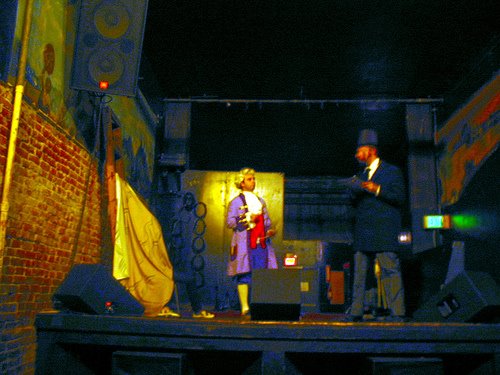
Stan Apps has a pretty decent overview of the experimental theatre event held last weekend at the Smell. And K. Lorraine Graham has some flickr pictures of her LA weekend, including the plays. The photo below is from Lorraine's series (Lorraine, I hope you don't mind I've pilfered it!). That's me in the French marquis outfit. Andrew Maxwell is Abe Lincoln. Rita Gonzalez is on the left, obscured by a sheet/curtain/sail.

Tuesday, August 01, 2006
We’re having a timely conversation over at Stan Apps’ blog about violence, aesthetics, the
Friday, July 28, 2006
Vast Arcade Los Angeles
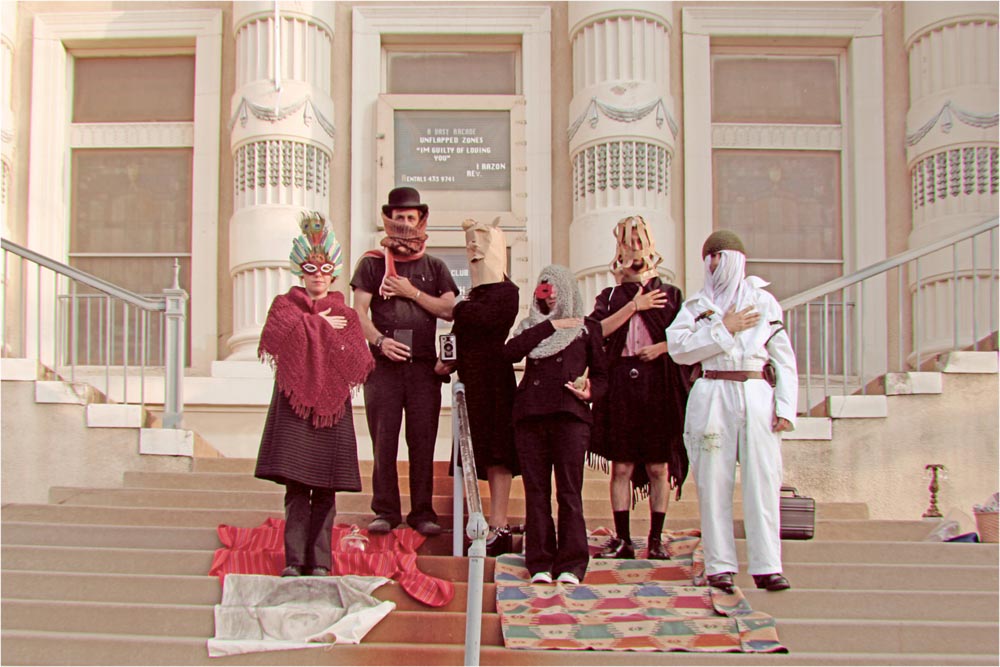
(click on photo to enlarge)
“Dr. Eufencio Rojas!”...
“Presente”
“Liki Renteria!”...
“Ehh!”
“George Lopez”...
(Silence)
“El Pendejo!!”...
“Soy Yo!”
“Antonio Villaraigosa!"...
(Sound of locked jawbone cracking)
“Dr. Renato Frias!"...
(Low frequencies)
All are gathered here to pick up the parts and play with the remnants of Sr. Romo’s backhands.
First, let’s examine this document entitled, The Crystal Brilliance Manifesto. We have all studied The Art of Noises, have we not? Do you sense a rupture in the seams of 20th century art history now that we have come to a point where we can conjure the Futurists perfectly at home on Whittier Blvd?
Your Crystal Brilliance Manifesto loops los planes (which we remember were penned with blood, cactus, and semen) with the escritos of David Alfaro Siqueiros. His seemingly hazardous development was “an antinomic double objective: on one hand, encouraging the development of "new means" for literature and the visual arts through the incorporation of avant-garde principles; on the other, the promotion of truly independent perspectives based on the recovery of indigenous traditions.” (Mari Carmen Ramirez)
Romo, you penned, “Think of a mural dedicated to double vision, to sound, to the dead twin of the puff of smoke that you released from your lungs one night, to the long faded trails of movement left behind by your hands pushing into the concrete. Sounds should pass through your mind about now, wooshes and abstract noises and fractal like guffaws, hoots and car horns."
And then a crash defines the disso-stinct…and then we see the cinematic trails of Siqueiros project which somehow landed in Sergei Eisenstein’s erotic film bins.
Sr. Romo, think back to the Futurists’ dream of a mural dedicated to sound—think of Russolo’s praise of the-- “crashing down of metal shop blinds, slamming doors, the hubbub and shuffling of crowds, the variety of din, from stations, railways, iron foundries, spinning mills, printing works, electric power stations and underground railways…” (Russolo 85 Futurist Manifestos, edited by Umbro Apollonio, Boston, Museum of Fine Arts Publications, 2001: 74-77.)-from Vast Arcade Los Angeles: An Introduction to the Project by way of an Interview Conducted by Rita Gonzalez at the Home of Arturo Romo, 8/20/05
Arturo Romo's Vast Arcade Los Angeles can currently be seen along with Kalup Linzy's All My Children at LAX Art in Los Angeles.
Thursday, July 27, 2006
This should go in the comments section of Silliman’s Blog, but he’s turned his comments off, so I’ll respond here.
In response to Sherwood Anderson’s 1918 poem “Song to New Song”, Ron writes:
Several things in this text stand out, above & beyond the obvious influence of Whitman. One is the fact that there is nothing personal here about the use of the first person singular. Is “I” here even a person? More accurately, it strikes me as a rhetorical position. Nor is there anything personal, even personified, about “you,” bird man of the furnaces. Rather, this is a kind of public, figurative language we hardly hear any more, save possibly in church. If it seems preposterous or stilted or dated, that is the index of just how far outside our expectations such language is today within the poem.
Ron is referring to Sherwood Anderson’s rhetorical, and presumably communal, use of I and you: “I greet thee, horse and terrible singer, half man, half bird, strong, winged one./I see you float in cold bleak winds,/Your wings burned by the fires of furnaces…”
My first thought was that this language is epic language, and that indeed one occasionally does find such language used in contemporary poetry, if only ironically . My second thought was of Juliana Spahr and her repeated address to “Beloveds” and her use of the rhetorical I in her book This Connection of Everyone with Lungs (Spahr was also ready-at-mind for Gabe Gudding). Finally, I recalled the very common use of infinitives that function rhetorically, figuratively, and publicly, and that are often composed as lists in much contemporary poetry. This sort of infinitival excessiveness is the syntactic soft spot into which the public I and rhetorical you have recently wiggled: “To labor night and day/To bear rain or wind/To eat badly and to sleep badly, etc., etc.” In Heretical Imperialism Pier Paolo Pasolini calls this the “inchoative infinitive”:
…. “inchoative,” that is, as description of repeated actions – always because of a normativity alluded to with the absolute certainty of being understood, of exciting sympathetic sentiments in other people who not only have had similar experiences but who don’t even have the possibility of thinking for themselves of different experiences….The infinitival category […] in any case implies a humble and, I would say, labor-union-like epic quality: and so it does not imply only a simple “reanimation” of the speech of a speaker as a statistically and above all socially individualized particular character, but of a typical speaker, a representative of a whole category of speakers, thus of a milieu, even a people….The sympathy of the author in reanimating his speech grammatically thus doesn’t go out to him, but to all those like him, to his world.
This Weekend in Los Angeles
Poet's Theatre at the Last Sunday of the Month Reading Series
@The Smell
Plays
The Mummer's Play by Vanessa Place
starring Christine Wertheim, Matias Viegener, Teresa Carmody, Vanessa Place, and Maude Place as Twing Twang
Bad Fuggums by Joseph Mosconi
starring Andrew Maxwell, Rita Gonzalez, and Joseph Mosconi
Rootbots by Matt Timmons
starring Steph Rioux, Stan Apps, and Matt Timmons
excerpts from Conduction in the Catacombs, by Will Alexander
starring Tova Cooper and Alison McDonell
Optimist Meets Pessimist by Stan Apps
starring Brook Haley and Jen Rust
What Do You Know of Ghosts? by K. Lorraine Graham
starring K. Lorraine Graham and Mark Wallace
sections from Dark Carnival by Mark Wallace
starring K. Lorraine Graham and Mark Wallace
Balm to Bilk by Rodrigo Toscano
starring K. Lorraine Graham and Mark Wallace
Monkeys in the House by Harold Abramowitz
starring Steph Rioux, Stan Apps, and Matt Timmons
------------
Doors open at 6:30. $5 at the door to support artistes.
The Smell
247 S. Main Street
Los Angeles, CA
Please don't throw rotten vegetables. I've never written a play before.
Also:
The 3rd installment of Long Beach Notebook
Saturday, July 29, 8PM
Aaron Kunin
Jen Benka
&
Ara Shirinyan
Aaron Kunin is the author of Folding Ruler Star (Fence Books, 2005), a collection of small poems about shame. The Mandarin, a novel, is forthcoming in 2007. He lives in California and teaches negative anthropology at Pomona College.
Ara Shirinyan is writer and editor of Make Now Press in Los Angeles. He curates the Last Sunday of the Month Reading Series at the Smell in Los Angeles with Stan Apps and Teresa Carmody. His chapbook Handsome Fish Offices is due out later this year on INSERT PRESS.
Jen Benka's collection, A Box of Longing With Fifty Drawers, which is comprised of one poem for each of the 52 words in the Preamble, was published by Soft Skull Press in 2005. She is also the author of the Eisner-nominated indy comic book series, Manya. She is the recipient of grants and awards from Intermedia Arts, the Poetry/Film Workshop, Wisconsin Arts Board, and the Xeric Foundation. She works as the managing director of Poets & Writers, and on the side, organizes poetry events, which have included a 24-hour marathon reading of the complete poems of Emily Dickinson, a protest reading during the 2005 Republican National Convention, and currently, a 5-night festival celebrating women poets. She lives in New York City.
LONG BEACH NOTEBOOK is held at the home & office of Palm Press:
143 Ravenna Drive
Long Beach, CA 90803
@The Smell
Plays
The Mummer's Play by Vanessa Place
starring Christine Wertheim, Matias Viegener, Teresa Carmody, Vanessa Place, and Maude Place as Twing Twang
Bad Fuggums by Joseph Mosconi
starring Andrew Maxwell, Rita Gonzalez, and Joseph Mosconi
Rootbots by Matt Timmons
starring Steph Rioux, Stan Apps, and Matt Timmons
excerpts from Conduction in the Catacombs, by Will Alexander
starring Tova Cooper and Alison McDonell
Optimist Meets Pessimist by Stan Apps
starring Brook Haley and Jen Rust
What Do You Know of Ghosts? by K. Lorraine Graham
starring K. Lorraine Graham and Mark Wallace
sections from Dark Carnival by Mark Wallace
starring K. Lorraine Graham and Mark Wallace
Balm to Bilk by Rodrigo Toscano
starring K. Lorraine Graham and Mark Wallace
Monkeys in the House by Harold Abramowitz
starring Steph Rioux, Stan Apps, and Matt Timmons
------------
Doors open at 6:30. $5 at the door to support artistes.
The Smell
247 S. Main Street
Los Angeles, CA
Please don't throw rotten vegetables. I've never written a play before.
Also:
The 3rd installment of Long Beach Notebook
Saturday, July 29, 8PM
Aaron Kunin
Jen Benka
&
Ara Shirinyan
Aaron Kunin is the author of Folding Ruler Star (Fence Books, 2005), a collection of small poems about shame. The Mandarin, a novel, is forthcoming in 2007. He lives in California and teaches negative anthropology at Pomona College.
Ara Shirinyan is writer and editor of Make Now Press in Los Angeles. He curates the Last Sunday of the Month Reading Series at the Smell in Los Angeles with Stan Apps and Teresa Carmody. His chapbook Handsome Fish Offices is due out later this year on INSERT PRESS.
Jen Benka's collection, A Box of Longing With Fifty Drawers, which is comprised of one poem for each of the 52 words in the Preamble, was published by Soft Skull Press in 2005. She is also the author of the Eisner-nominated indy comic book series, Manya. She is the recipient of grants and awards from Intermedia Arts, the Poetry/Film Workshop, Wisconsin Arts Board, and the Xeric Foundation. She works as the managing director of Poets & Writers, and on the side, organizes poetry events, which have included a 24-hour marathon reading of the complete poems of Emily Dickinson, a protest reading during the 2005 Republican National Convention, and currently, a 5-night festival celebrating women poets. She lives in New York City.
LONG BEACH NOTEBOOK is held at the home & office of Palm Press:
143 Ravenna Drive
Long Beach, CA 90803
Thursday, July 20, 2006
 E-Mail Spam as a Masterpiece in the Making
When Romanian artist Alex Dragulescu looks at junk e-mails, he sees patterns - bits and bytes that can be manipulated into colorful plantlike images or stark architectural forms.
As a graduate student at the University of California, San Diego, he and fellow student Tim Jaeger collected spam and used it to create live multimedia shows of sound, text, and animation - "like a VJ and DJ performance," Mr. Dragulescu says in a phone interview.
..............................................................................................
Monday, July 17, 2006
The Neo-Benshi craze finally found its way to Los Angeles.

Only here it's called Da Benshi in order to differentiate it from the Bay Area chapter. Like Berlin and Zurich DaDa?
Amar Ravva and Harold Abramowitz are curating the bi-monthly live film (or video) narration series at Beta-Level in Chinatown (Da Benshi Code is the official series name).
The Mask of Zardoz is its logo.
Saturday night was Episode 1: My Dog Benshi, featuring "Jury Duty" by Oliver Hall (A Few Good Men served as the source text; instead of being court-martialed, Jack Nicholson was brought to court for...); "Monster" by Jason Brown (Jason used a sampler and turntable to narrate a collage of silent monster films); and "Bubonic Phonics" by DJ Eng (found footage of a squirrel met a live human chorus shouting "Bu-bo-nic Plague!").
The highlight of the night, however, was "Goooaaalll!!!" by Stan Apps and Mathew Timmons. Stan was out of town, so his disembodied pre-recorded voice ineracted with Matt's live narration as they scoured the tubby universe of Spanish commercials and trash television.
Guess who they found there?
Jim Behrle, "the poet capitalist", "the fruit of the loom of romanticism".
Lucky for us, Stan and Matt have taken a video polaroid for posterity.
Watch Goooaaalll!!! by Stan Apps and Mathew Timmons on YouTube:
Part 1
Part 2
And check out Harold Abramowitz's chapbook Three Column Table out now on Insert Press (no website yet, but query Stan or Matt for copies).

Only here it's called Da Benshi in order to differentiate it from the Bay Area chapter. Like Berlin and Zurich DaDa?
Amar Ravva and Harold Abramowitz are curating the bi-monthly live film (or video) narration series at Beta-Level in Chinatown (Da Benshi Code is the official series name).
The Mask of Zardoz is its logo.
Saturday night was Episode 1: My Dog Benshi, featuring "Jury Duty" by Oliver Hall (A Few Good Men served as the source text; instead of being court-martialed, Jack Nicholson was brought to court for...); "Monster" by Jason Brown (Jason used a sampler and turntable to narrate a collage of silent monster films); and "Bubonic Phonics" by DJ Eng (found footage of a squirrel met a live human chorus shouting "Bu-bo-nic Plague!").
The highlight of the night, however, was "Goooaaalll!!!" by Stan Apps and Mathew Timmons. Stan was out of town, so his disembodied pre-recorded voice ineracted with Matt's live narration as they scoured the tubby universe of Spanish commercials and trash television.
Guess who they found there?
Jim Behrle, "the poet capitalist", "the fruit of the loom of romanticism".
Lucky for us, Stan and Matt have taken a video polaroid for posterity.
Watch Goooaaalll!!! by Stan Apps and Mathew Timmons on YouTube:
Part 1
Part 2
And check out Harold Abramowitz's chapbook Three Column Table out now on Insert Press (no website yet, but query Stan or Matt for copies).
Tuesday, July 11, 2006
Oh yeah? This morning I received this:
"Well, are you pleased?"
He was glowing, positively radiant, grinning as good as the best of any literature. Looked clean. The antennas screwed up the effect though--they were overgrown instructor's level.
"Well, are you pleased?"
He was glowing, positively radiant, grinning as good as the best of any literature. Looked clean. The antennas screwed up the effect though--they were overgrown instructor's level.
Friday, July 07, 2006
Went to see the Dying Californian, my old college housemates, play at Mr. T's Bowl. Saw perhaps the best men's room grafiti ever:
"Fuck this existentialist drama."
-Louis Ferdinand Celine
"Fuck this existentialist drama."
-Louis Ferdinand Celine
Japanese improvisationalist Tetuzi Akiyama brought his guitars (acoustic, electric, mystic) to the experimental music series at the Schindler House last month for his first ever performance in Los Angeles. The night was cool, the crickets were chirping, and the occasional helicopter cruised by in the distance overhead as Akiyama strummed his acoustic, and then, after a short Campari break, boogied with his electric. I don’t own the vocabulary of a music critic, but I would guess that Akiyama’s acoustic noisy twangs & plucks are greatly influenced by Derek Bailey. The electric half of the show was conceptual: Akiyama essentially played a single classic rock riff for, oh, five to ten minutes, and then switched to another classic rock riff, which was also repeated for several minutes. It was very “dorm room”, but as my friend Jon said, the entire “rock” portion of the performance was put into relief by the more experimental acoustic half; many Derek Bailey style experimentalists can easily play “rock” but it’s not often that the rockers can play Derek Bailey.
Subscribe to:
Posts (Atom)