Friday, March 11, 2005

Friday, February 04, 2005
What I Heard About Iraq by Eliot Weinberger
Thursday, January 27, 2005

A new multiple by Paige Gratland (1" clip-on grey hair extension) in commemoration of the late great Susan Sontag
Wednesday, January 19, 2005

still from Star Spangled to Death, Ken Jacobs
My year-end film list does not include “favorites”; it is not a top-ten (though I have limited it, by convention, to ten films in each category) and it is not a “best-of” list. I’m increasingly dissatisfied with simply liking certain films. Did I like that edited version of Elf I saw on the plane between
Newly Released Films
Twenty-Nine Palms (Bruno Dumont)
Woman is the Future of Man (Hong Sang-soo)
The 5 Obstructions (Lars von Trier & Jorgen Leth )
Notre musique (Jean-Luc Godard)
Dogville (Lars von Trier)
Bad Education (Pedro Almodóvar)
Blissfully Yours (Apichatpong Weerasethakul)
Star Spangled to Death (Ken Jacobs)
Tropical Malady (Apichatpong Weerasethakul)
Re-releases and Revivals
Playtime (Jacques Tati)
The
Tres tristes tigres (Raoul Ruiz)
Au hasard Balthazar (Robert Bresson)
I Vitelloni (Federico Fellini)
The Exiles (Kent MacKenzie)
Film About a Woman Who…(Yvonne Rainer)
Jeanne Dielman, 23 Quai du Commerce, 1080 Bruxelles (Chantal Akerman)
Sympathy for Mr. Vengeance (Park Chan-wook)
Bless Their Little Hearts (Billy Woodberry)
Notable
Distant (Nuri Bilge Ceylan)
Eternal Sunshine of the Spotless Mind (Michel Gondry)
Last Life in the Universe (Pen-Ek Ratanaruang)
The Return (Andrei Zvyagintsev)
Crimson Gold (Jafar Panahi)
Vera Drake (Mike Leigh)
Ten (Abbas Kiarostami)
Remembrance of Things to Come (Chris Marker & Yannick Bellon)
Moolaadé (Ousmane Sembene)
Henri Langlois: The Phantom of the Cinematheque (Jacques Richard)
Movies I Want to See ASAP
2046 (Wong Kar Wai)
Café Lumiere (Hou Hsiao-hsien)
Cinévardaphoto (Agnès Varda)
The Holy Girl (Lucrecia Martel)
L’Intrus (Claire Denis)
Trilogy: The Weeping Meadow (Theo Angelopoulos)
The World (Jia Zhang Ke)
Old Boy (Park Chan-wook)
Kings and Queen (Arnaud Desplechin)
Clean (Olivier Assayas)
A Hole in My Heart (Lukas Moodysson)
Monday, January 10, 2005

Salomon Huerta, Untitled Head (2002)
The New Chicano Movement by Josh Kun
(excerpt)
"I don't think I make Chicano art," says [artist Mario Ybarra, Jr.], standing in Slanguage's backroom, which is cluttered with Mac computers, crates of records, an Osama bin Laden piñata and a spray-painted portrait of reggae singer Jimmy Cliff. "It's something I have learned as a history and acquired as a filter. But right now, I don't think I could say I'm making it. It's like saying I make abstract expressionist painting. I'm not an ab-ex painter. I can't go back and make that art. I make contemporary art that is filtered from a Mexican American experience in Los Angeles."
Ybarra thinks of it as the Edward James Olmos theory of Chicano art. He wants to be less like the actor in "American Me" and "Zoot Suit"—in which Olmos was prison tough and pachuco savvy—and more like Olmos' character in "Blade Runner." In the film's dystopian 2029 L.A. future, Olmos is Gaff—a digital urban polyglot, a Chinese Chicano detective who speaks a street patois of English, Spanish, French, Chinese, Hungarian and German.
"My main drive," says Ybarra, "is not to learn Nahuatl, but to learn Mandarin or Cantonese."

Mario Ybarra, Jr., Go Tell It, 2004
Wednesday, January 05, 2005

David Thorne, Be Happy
image courtesy Clockshop
Projects off-line have barred my expansiveness on-line. Here’s a New Year’s resolution to improve my bloggy rigor and vigor. In the meantime, those living in Los Angeles can hear what I’ve been up to this Saturday night at the galleries at 6150 Wilshire. I’ll be reading from an essay I co-wrote with Rita Gonzalez that will be included in an artist’s monograph. Read more about the project below.
Image Control: Billboard Oases
Clockshop.org
Clockshop hosts a closing event at 6150 Wilshire Blvd., Saturday, January 8, from 6 to 8 p.m., to coincide with the publication of a limited-edition book about the project. For information, call (323) 666-2599.
Tuesday, December 21, 2004
Thursday, December 16, 2004

Friday, December 03, 2004
Wednesday, December 01, 2004
Gay Book Ban Goal of State Lawmaker
(registration required)
An Alabama lawmaker who sought to ban gay marriages now wants to ban novels with gay characters from public libraries, including university libraries.
A bill by Rep. Gerald Allen, R-Cottondale, would prohibit the use of public funds for "the purchase of textbooks or library materials that recognize or promote homosexuality as an acceptable lifestyle." Allen said he filed the bill to protect children from the "homosexual agenda."
"Our culture, how we know it today, is under attack from every angle," Allen said in a press conference Tuesday.
Allen said that if his bill passes, novels with gay protagonists and college textbooks that suggest homosexuality is natural would have to be removed from library shelves and destroyed.
I should point out that such a law would make illegal the works of Plato, Petronius, Marcel Proust, Andre Gide, Thomas Mann, Gertrude Stein, Virginia Wolfe, Oscar Wilde, Tennessee Williams, Evelyn Waugh, Herman Melville, Jean Genet, E.M. Forster, James Baldwin, Alice Walker, ad infinitum.
***
As promised, here is a link to the full text version of Slavoj Zizek's Somewhere Over the Rainbow. (via Charlotte Street).
Thursday, November 04, 2004
Wednesday, November 03, 2004
Tuesday, November 02, 2004
Wednesday, October 13, 2004
Monday, September 20, 2004

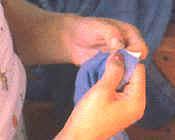
Don’t know what film these stills were taken from, but they convey the idea. I can only imagine Morgan managed to conjure up something magnificent. Hope it screens again sometime. Also showing was Thom “Los Angeles Plays Itself” Andersen’s --- ------- aka Short Line, Long Line (the first film in the wordless title meme?) which I caught last year, and which parodies rock and roll of the 1966 variety, as well as Eisenstein’s dialectical film montage, if you can believe that. It’s been awhile, but I recall a highly structured film: short shots of various rockers, jazzmen, and 60s scenarios, followed by long shots of the same, growing in length up to the apogee, then turning heel, shortening in length to the end of the whole shebang. But anyway: I did manage to see, Thursday last, a three-and-a-half hour documentary on Henri Langlois, that phantom of the cinematheque, entitled Henri Langlois, the Phantom of the Cinematheque. I was aware of but not versed in Langlois’ essential role in preserving film prints throughout the war (storing canisters in bath tubs and transporting them in baby carriages to hide them from the Nazis) and on through the 1970s. The documentary makes the case for Langlois as a “poet of the archive” who screened films thematically, often intuitively, sometimes strategically. Langlois recalls trading away a Theda Berra film very early in his career, assuming it was meaningless fluff, and not realizing the treasure he briefly held. The Langlois Lesson: hold on to it all, you can never foresee the vagaries of critical reception. I concur hesitantly, if only because I’m suspicious of the nostalgia so many from my generation feel for vintage television commercials (Schoolhouse Rocks, say, or Hey Mikey, He Likes It), nostalgia which often consigns (false) value to such cultural ephemera.
Thursday, September 16, 2004
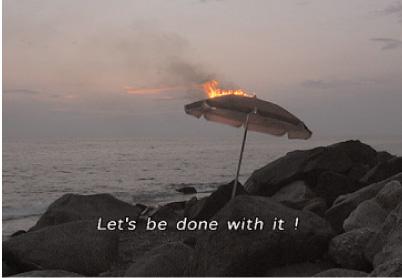
Bernadette Corporation, Get Rid of Yourself, 2002, still from a color digital video, 70 minutes, via Artforum.com
Reading:
Bennett Simpson, Techniques of Today. Artforum, September 2004. It is the summer of 2001, and the New York– and Paris-based collective known as Bernadette Corporation has temporarily merged with Le Parti Imaginaire, a faction of post-Situationist militants and intellectuals with links to the burgeoning antiglobalization movement. The two groups have their own distinct practices and motivations, but, for the moment, they are united by the idea of making a film, which is to be set in the seaside Italian city of Genoa, amid the protests and stultifying inconclusiveness that will engulf the G8 Summit that July. The film resists knowing what it is or wants to be. And so its makers improvise, exploring what they call the "potential of community based on a radical refusal of political identity." More on Le Parti Imaginaire (in French) and the Bernadette Corporation.
Chris Kraus, Video Green: Los Angeles Art and the Triumph of Nothingness. Semiotext(e), 2004. Art and commerce have always been two sides of the same coin and to oppose them would be false. Instead, I am talking about a shift that has taken place during the past ten years in how art objects reach the market, how they are defined and how we read them. The professionalization of art production – congruent with specialization in other post-capitalist industries – has meant that the only art that will ever reach the market now is art that is produced by graduates of art schools. The life of the artist matters very little. What life? The lives of successful younger artists are practically identical.
(note bene: I believe this is changing, slowly. For successful non-MFA artists based in Los Angeles see Animal Charm and Miranda July – though it’s debatable whether these artists are “marketable” or not).
Péter Esterházy, The Glance of Countess Hahn-Hahn (down the Danube). Northwestern University Press, 1999. I once had this mysterious, distant uncle, whom everyone simply called Roberto, as if he were some Italian gigolo. Everyone, that is, except my father, who didn’t call him anything at all: the man’s name ‘never so much as passed his lips’. He wasn’t a blood relation. It was as the husband of a kind of aunt that he briefly became part of the family, joining it at precisely the point where the two sides, maternal and paternal, playfully and fatefully joined hands. A river is always the same river, however many arms it has. More on Péter Esterházy.
Received:
Black Spring, Winter 2004.
The Poker, issues 1,2,3 & 4.
Update: Paris’s new slant on Underground movies. A group calling itself La Mexicaine de la Perforation has claimed responsibility for the secret subterranean cinema in the catacombs of Paris, mentioned below. To be fair, until recently very few people did have a clue about La Mexicaine de la Perforation, a clandestine cell of "urban explorers" which claims its mission is to "reclaim and transform disused city spaces for the creation of zones of expression for free and independent art".
Wednesday, September 08, 2004
Police in Paris have discovered a fully equipped cinema-cum-restaurant in a large and previously uncharted cavern underneath the capital's chic 16th arrondissement. [...] After entering the network through a drain next to the Trocadero, the officers came across a tarpaulin marked: Building site, No access. Behind that, a tunnel held a desk and a closed-circuit TV camera set to automatically record images of anyone passing. The mechanism also triggered a tape of dogs barking, "clearly designed to frighten people off," the spokesman said. Further along, the tunnel opened into a vast 400 sq metre cave some 18m underground, "like an underground amphitheatre, with terraces cut into the rock and chairs". There the police found a full-sized cinema screen, projection equipment, and tapes of a wide variety of films, including 1950s film noir classics and more recent thrillers. None of the films were banned or even offensive, the spokesman said. A smaller cave next door had been turned into an informal restaurant and bar. "There were bottles of whisky and other spirits behind a bar, tables and chairs, a pressure-cooker for making couscous," the spokesman said. [...] Three days later, when the police returned accompanied by experts from the French electricity board to see where the power was coming from, the phone and electricity lines had been cut and a note was lying in the middle of the floor: "Do not," it said, "try to find us."
No word on whether or not they had The Phantom of Liberty (or Phantom of the Paradise) in stock. Link via greg.org via BoingBoing via DMD (amazing how these stories spread).