The city burning is
- Joan Didion, “
The city burning is
- Joan Didion, “

ƒeminaissance is a colloquium on women, experimental writing and feminism, to be held on April 27th and 28th, 2007, at the Museum of Contemporary Art (MOCA). A related workshop and consciousness-raising event will take place on Sunday, April 29th at LACE, in Hollywood.
This event is organized by Christine Wertheim, Matias Viegener, and Teresa Carmody and is sponsored by the Writing Program at CalArts with a generous grant from the Annenberg Foundation. Feminaissance is presented in conjunction with MOCA’s show “WACK: Art and Feminist Revolution.” The colloquium puts writers from many genres in dialogue about issues concerning women writers today.
FRIDAY, April 27, 2007
MOCA, 250 S. Grand Avenue, LA, CA 90012
7 pm Reception
8 pm Readings by Caroline Bergvall, Teresa Carmody, Meiling Cheng, Bhanu Kapil, Chris Kraus, Tracie Morris, Christine Wertheim, Stephanie Young, and Lidia Yuknavitch
SATURDAY, April 28, 2007
MOCA, 250 S. Grand Avenue, LA, CA 90012
10:30 am-12:00 pm
Panel: “Feminine” Writings
Are there specifically “feminine” texts, topics and modes of writing? Or is the concept of “écriture féminine” more hindrance than help?
Panelists: Caroline Bergvall, Meiling Cheng, Chris Kraus, and Lidia Yuknavitch
12:20—1:50 pm
Panel: Selves
Are women writers creating new forms of selfhood? If so, how does this manifest in the subject and/or perspective of the work and in the object, i.e., the formed text?
Panelists: Tracie Morris, Vanessa Place, and Christine Wertheim
LUNCH BREAK
3:15—4:45 pm
Panel: The Social
Can women writers effect the social imaginary in ways that positively change our psycho-sexual organization? Are they obliged to, or is this another version of mothering that restricts women?
Panelists: Dodie Bellamy, Bhanu Kapil, Yxta Maya Murray, Maggie Nelson
5:00—6:30 pm
Panel: Categories
What is gender today? Are the terms “gender” and feminism still useful in writing? Or are we in a post- or trans-gendered era, and to what intent social, representational, aesthetic, activist?
Panelists: Wanda Coleman, Susan McCabe, Eileen Myles, and Juliana Spahr & Stephanie Young
DINNER BREAK
8:30 Readings by Dodie Bellamy, Wanda Coleman, Susan McCabe, Yxta Maya Murray, Eileen Myles, Maggie Nelson, Vanessa Place and Juliana Spahr
SUNDAY, APRIL 29, 2007
LACE, 6522 Hollywood Boulevard, Los Angeles, CA 90028
2-6 pm Potluck and consciousness-raising workshop on MOTHER: literary, real, symbolic and edible. Led by Bhanu Kapil, Eileen Myles and Chris Kraus.
2. Around Photography
Around Photography is a unique two-day conference organized by UCLA’s Department of Art that brings together a range of prominent artists, filmmakers, critics, and curators. A presentation by Berlin-based artist and filmmaker Tacita Dean on Tuesday, April 24, and an evening of artist films in the Billy Wilder Theater on Thursday, April 26, run in conjunction with the conference.
FRIDAY 27 APRIL | Day I
7pm
Photography's Expanded Field
Moderated by Professor George Baker, UCLA Department of Art History and an Editor of the journal October, artists Barbara Probst, Nancy Davenport and curator Douglas Fogle will introduce the subject of photography's discourse with other media.
SATURDAY 28 APRIL | Day II
11am
The Archive Reconsidered
Moderated by Professor Eleanor Kaufman, Department of Comparative Literature, UCLA artists Professor Catherine Opie, Department of Art, UCLA, Joel Sternfeld, and critic Jan Tumlir will address issues of taxonomy and politics as a means of investigating the photographic dimensions of what theorists have termed "an archival impulse" within contemporary art.
2pm
A New Luminism
Moderated by Professor James Welling, Department of Art, UCLA, art historian Professor Jonathan Crary, Department of Art History, Columbia University and artists Uta Barth and Anthony McCall will focus on issues of light, space and perception as a way of broadening conventional notions of the photographic.
LOCATION:
HAMMER Museum| Gallery
10899 Wilshire Blvd
The Smell
247 S. Main, Los Angeles, CA 90012 [enter in back]
Between 2nd and 3rd Street
6:30 pm
 My partner Rita Gonzalez and I wrote the "liner notes" for Animal Charm's compilation DVD, just out on Other Cinema. Check it out.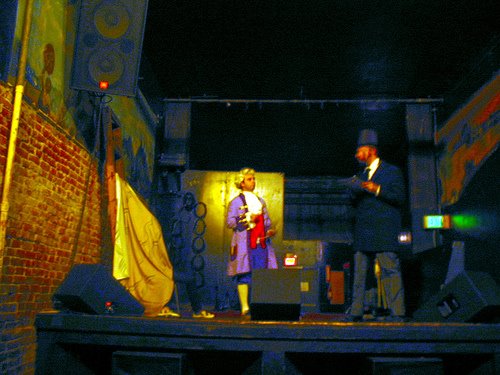
We’re having a timely conversation over at Stan Apps’ blog about violence, aesthetics, the
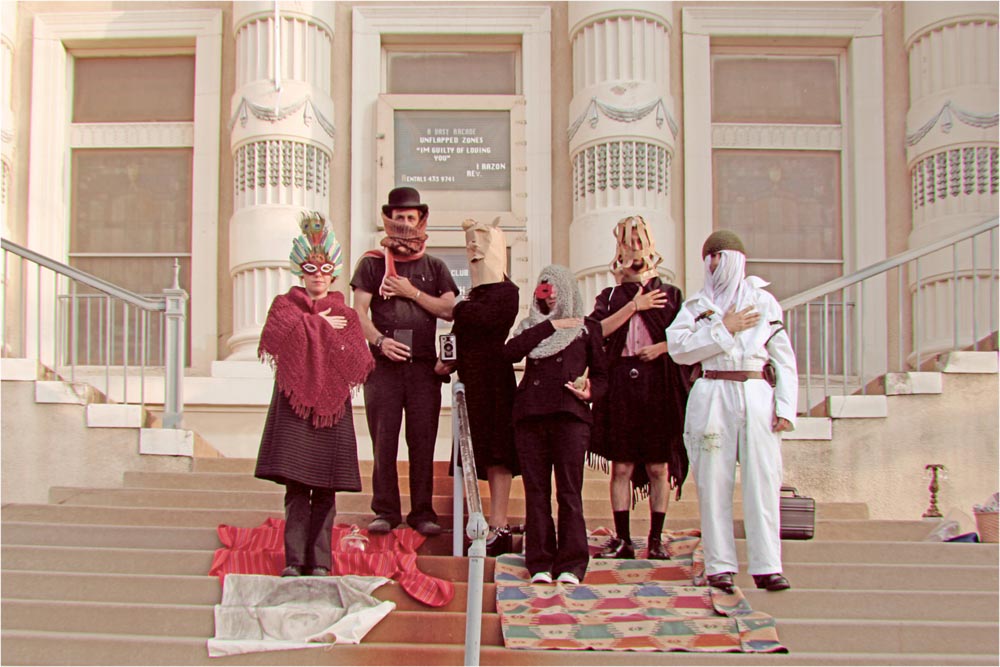
All are gathered here to pick up the parts and play with the remnants of Sr. Romo’s backhands.
First, let’s examine this document entitled, The Crystal Brilliance Manifesto. We have all studied The Art of Noises, have we not? Do you sense a rupture in the seams of 20th century art history now that we have come to a point where we can conjure the Futurists perfectly at home on Whittier Blvd?
Your Crystal Brilliance Manifesto loops los planes (which we remember were penned with blood, cactus, and semen) with the escritos of David Alfaro Siqueiros. His seemingly hazardous development was “an antinomic double objective: on one hand, encouraging the development of "new means" for literature and the visual arts through the incorporation of avant-garde principles; on the other, the promotion of truly independent perspectives based on the recovery of indigenous traditions.” (Mari Carmen Ramirez)
Romo, you penned, “Think of a mural dedicated to double vision, to sound, to the dead twin of the puff of smoke that you released from your lungs one night, to the long faded trails of movement left behind by your hands pushing into the concrete. Sounds should pass through your mind about now, wooshes and abstract noises and fractal like guffaws, hoots and car horns."
And then a crash defines the disso-stinct…and then we see the cinematic trails of Siqueiros project which somehow landed in Sergei Eisenstein’s erotic film bins.
Sr. Romo, think back to the Futurists’ dream of a mural dedicated to sound—think of Russolo’s praise of the-- “crashing down of metal shop blinds, slamming doors, the hubbub and shuffling of crowds, the variety of din, from stations, railways, iron foundries, spinning mills, printing works, electric power stations and underground railways…” (Russolo 85 Futurist Manifestos, edited by Umbro Apollonio, Boston, Museum of Fine Arts Publications, 2001: 74-77.)This should go in the comments section of Silliman’s Blog, but he’s turned his comments off, so I’ll respond here.
In response to Sherwood Anderson’s 1918 poem “Song to New Song”, Ron writes:
Several things in this text stand out, above & beyond the obvious influence of Whitman. One is the fact that there is nothing personal here about the use of the first person singular. Is “I” here even a person? More accurately, it strikes me as a rhetorical position. Nor is there anything personal, even personified, about “you,” bird man of the furnaces. Rather, this is a kind of public, figurative language we hardly hear any more, save possibly in church. If it seems preposterous or stilted or dated, that is the index of just how far outside our expectations such language is today within the poem.
Ron is referring to Sherwood Anderson’s rhetorical, and presumably communal, use of I and you: “I greet thee, horse and terrible singer, half man, half bird, strong, winged one./I see you float in cold bleak winds,/Your wings burned by the fires of furnaces…”
My first thought was that this language is epic language, and that indeed one occasionally does find such language used in contemporary poetry, if only ironically . My second thought was of Juliana Spahr and her repeated address to “Beloveds” and her use of the rhetorical I in her book This Connection of Everyone with Lungs (Spahr was also ready-at-mind for Gabe Gudding). Finally, I recalled the very common use of infinitives that function rhetorically, figuratively, and publicly, and that are often composed as lists in much contemporary poetry. This sort of infinitival excessiveness is the syntactic soft spot into which the public I and rhetorical you have recently wiggled: “To labor night and day/To bear rain or wind/To eat badly and to sleep badly, etc., etc.” In Heretical Imperialism Pier Paolo Pasolini calls this the “inchoative infinitive”:
…. “inchoative,” that is, as description of repeated actions – always because of a normativity alluded to with the absolute certainty of being understood, of exciting sympathetic sentiments in other people who not only have had similar experiences but who don’t even have the possibility of thinking for themselves of different experiences….The infinitival category […] in any case implies a humble and, I would say, labor-union-like epic quality: and so it does not imply only a simple “reanimation” of the speech of a speaker as a statistically and above all socially individualized particular character, but of a typical speaker, a representative of a whole category of speakers, thus of a milieu, even a people….The sympathy of the author in reanimating his speech grammatically thus doesn’t go out to him, but to all those like him, to his world.
 E-Mail Spam as a Masterpiece in the Making
As a graduate student at the University of California, San Diego, he and fellow student Tim Jaeger collected spam and used it to create live multimedia shows of sound, text, and animation - "like a VJ and DJ performance," Mr. Dragulescu says in a phone interview.
..............................................................................................

Tonight, 7:30 PM @ Beyond Baroque, Venice, CA
Native Californian JENNIFER MOXLEY is the author of Often Capital (Flood 2005), The Sense Record and other poems (Edge 2002; Salt 2003), Imagination Verses (Tender Buttons 1996; Salt 2003), and several chapbooks. Her poem “Behind the Orbits” was chosen by Robert Creeley for inclusion in The Best American Poetry 2002. She is the poetry editor for The Baffler magazine and a contributing editor of The Poker magazine. Since 1999 she has lived in Maine, where she teaches creative writing and literature at the University of Maine. AARON KUNIN is the author of Folding Ruler Star (Fence Books, 2005), a collection of small poems about shame. He recently moved to California, where he is an assistant professor of negative anthropology at Pomona College.
In the past, politicians promised to create a better world. They had different ways of achieving this, but their power and authority came from the optimistic visions they offered their people. Those dreams failed and today people have lost faith in ideologies. Increasingly, politicians are seen simply as managers of public life, but now they have discovered a new role that restores their power and authority. Instead of delivering dreams, politicians now promise to protect us: from nightmares.
They say that they will rescue us from dreadful dangers that we cannot see and do not understand. And the greatest danger of all is international terrorism, a powerful and sinister network with sleeper cells in countries across the world, a threat that needs to be fought by a War on Terror. But much of this threat is a fantasy, which has been exaggerated and distorted by politicians. It's a dark illusion that has spread unquestioned through governments around the world, the security services and the international media. This is a series of films about how and why that fantasy was created, and who it benefits.
At the heart of the story are two groups: the American neoconservatives and the radical Islamists. Both were idealists who were born out of the failure of the liberal dream to build a better world, and both had a very similar explanation of what caused that failure. These two groups have changed the world, but not in the way that either intended. Together, they created today's nightmare vision of a secret organised evil that threatens the world, a fantasy that politicians then found restored their power and authority in a disillusioned age. And those with the darkest fears became the most powerful. (From the opening narration to The Power of Nightmares).
Poet Jen Hofer opened the doors (and backyard gates) of her Cypress Park home Sunday night for the second installment of her Moving Word poetry and film series, co-curated by filmmaker David Gatten and featuring the work of several local luminaries. This must be the largest crowd any up-and-coming (heck, even established) LA writer or filmmaker will ever see. Jen has an invitation list in the hundreds and, unlike most salons, this one welcomes gate-crashers. The notoriously hard-to-park neighborhood was jam-packed with film, poetry and art lovers from far-flung burgs like
Filmmaker Rebecca Baron screened her early experimental short The Idea of North (1995). From the New York Film Festival website: In the guise of chronicling the final months of three polar explorers marooned on an ice floe a century ago, Baron's film investigates the limitations of images and other forms of record as means of knowing the past and the paradoxic interplay of film time, historical time, real time and the fixed moment of the photograph. Marrying matter-of-fact voiceover and allusive sound fragments, evidence and illustration, in Baron's words “meaning is set adrift.”
Andrew Choate read some funny Flarf-esque poetry (though I don’t believe he used Google to create the work) and he also held up hand-made signs with two-word poems written on them. I remember one of them: Ladycat Cadylac.
Susan Simpson screened a devastating new short, Boll Weevil Days (2005). Simpson, a puppeteer, created all the buildings and puppets in this short film. The plot dramatizes a nuclear or terrorist blast of some sort in
Maggie Nelson read from her book Jane: A Murder.
Amar Ravva performed a multimedia memoir (a video played behind him as he read) entitled
And finally, Lee Anne Schmitt and Lee Lynch screened a work-in-progress with live musical accompaniment by Devin McNulty about the last free-roaming buffalo herd in
I’ll try to post more frequently from here on out, I promise.