This Is Our Only World: A Report on the n/OULIPO Conference, Part 4
The final panel of the n/OULIPO conference was the “Summary Panel”, which included novelist Janet Sarbanes, art historian Johanna Drucker, and poet Tan Lin. Art and poetry critic Carrie Noland moderated. Sarbanes summarized the conference using an “I Remember” constraint, switching mid-talk to an “I Wonder” constraint. It was much more elegant than the rather long summary I’ve composed here, and since you can now read Sarbanes’ piece in its entirety over at Stephanie Young’s blog, I’ll move on to Johanna Drucker’s presentation. Drucker started by reading short poems that seemed to derive from keywords culled from each of the panelists’ talks. She explained that the long history of experimentalism in literature has two cultural traditions we can think about: Romanticism, which tends to the transcendental, and another nameless tradition that resists escape, resists the transcendental. Contra the theorization of much of the 20th century avant-garde, Drucker insists the “experiential” in experimentalism is not an act of liberation. She urges artists and writers to think of their work not as countercultural, but cultural. Drucker tires of the avant-garde and its strict pedanticism, which chides the adventurous artist, “you haven’t performed the avant-garde tradition correctly,” and pulls the artist back to a supposedly “liberating” space. She asked: what will the Oulipo be in 135 years? Her admittedly wicked answer: the seeds of current experimentalism will be muzak played in grocery stores; Perec will be handed out as reading material for kindergartners; in short, the strategies of the Oulipo will be absorbed and integrated into the cultural mainstream, and she looks forward to it.
Tan Lin spoke next, very briefly. As I mentioned before, he spoke of Stephanie Young & Juliana Spahr’s performance in relation to the “dated critical object” and wondered if there was a connection between Oulipian practice and the contemporary practice of sampling. Then something curious happened. Almost off-handedly (I didn’t notice it at first) Lin mentioned the “dematerialization” of the art-object. Johanna Drucker in response insisted that there is no such thing as dematerialization, that dematerialization is a myth. She claimed she had totally “lapsed” and no longer believes in the transcendental or utopian space (there seemed to be some slippage around the axis of terms “transcendental”, “utopian”, and “liberated space” that needed some sussing out). If we say that liberation or utopianism should be a goal in our cultural work, Drucker implied, we condemn ourselves to product-oriented results. Concerning dematerialization, Brian Kim Stefans asked from the audience: what about the data I lost on my computer last week? Drucker: That proves just how material the data was, that it was simply information imbedded on a silicon chip and subject to the laws of the material world. Stefans: what about the artist Vito Acconci and his performance Seedbed, where the artist hid underneath a gallery-wide ramp installed at the Sonnabend Gallery and masturbated while reciting his fantasies about the gallery-goers walking on the ramp above him? Drucker: sounds pretty material to me!
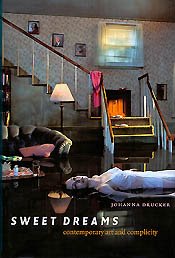
Johanna Drucker, Sweet Dreams:
Contemporary Art and Complicity
I’d like to think about Drucker’s remarks in the context of her latest book, Sweet Dreams: Contemporary Art and Complicity. There Drucker argues that much contemporary art has a complicit relationship with mass-media and the culture-industry, that art (or at least some art) no longer engages in the kind of oppositional critique that has been the hallmark of the avant-garde for the last century and a half, and that critical response to such art has failed to find a language to accommodate such changes. The rhetoric of radicality, says Drucker, has become formulaic and academic; opposition, negative criticality, and esoteric resistance are outmoded:
(Drucker, 49-50)
I must admit I was pretty angry when I first read this. I went to school in the mid-to-late 90s and was taught to think critically about culture; the writings of the
I’ll end on two lighter notes:
Johanna Drucker mentioned that hearing the Rolling Stones’ “You Can’t Always Get What You Want” as muzak in Wal-Mart is the ultimate defamiliarization experience. For members of my generation, however, this is totally familiar. Possibly even expected. “Smells Like Teen Spirit” was turned into muzak less than a year after it was top of the pops.
Paul Fournel said that the Oulipo was not so interested in constraints in the visual arts. I asked Ian Monk anyway whether the Oulipo had any official position on Lars von Trier’s Dogme 95 film movement, which seems influenced by Oulipian techniques. Monk stared into space, deep in memory: “The Celebration. What a terrific film.”